An ounce of prevention is worth a pound of cure
Benjamin Franklin, 1736
Most people think of this quote in terms of healthcare or personal wellbeing, but it has much wider relevance.
As someone who’s spent decades helping food businesses avoid and recover from crisis, I see the truth of it every day — especially when a business receives a 0 star hygiene rating.
In this post, I’ll expose some of the myths around a 0 star food hygiene rating, explain what it really means, why prevention is so important, and what to do if you ever receive that dreaded score.
Table of Contents
0 Star Hygiene Rating - Receiving A Crisis Call
I recently answered the phone to someone acting on behalf of a Turkish food business owner who had just received a 0 hygiene rating. Their immediate concern was to arrange Level 2 food safety training for staff, believing this would satisfy the health inspector.
However, based on my experience as an EHO, I know that a 0 hygiene rating is rarely down to staff training alone. It usually signals deeper, systemic issues. So, I began by asking a few key questions and requested to see the Environmental Health Officer’s (EHO) report. It’s important to tailor advice to the actual problem—not just offer a generic solution.
Before any documents were sent over, I asked the business owner whether formal enforcement action had been taken, or whether the health inspector had mentioned the risk of prosecution. He laughed—insisting that, because he’d known the inspectors for years, prosecution was not on the cards.
This is a common misunderstanding. A good relationship with the EHO does not mean enforcement action won’t be taken if standards aren’t met.
Role of An EHO
The belief that “the EHO is my friend” is something I often hear, and a common misconception.
This is understandable, and as part of my EHO training, we were introduced to the role of the Environmental Health Officer with this Latin phrase “Amicus Humani Generis” meaning “Friend of the Human Race.” This saying is used on the coat of arms of The Chartered Institute of Environmental Health, my professional body.
The reality is that the EHO is not your friend. Health officers, food inspectors, EHOs are given legal powers similar to Customs and Excise. This includes the right of entry into a food premises.
When things go wrong (which they will), the EHO’s job is to enforce food safety law using the tools of their trade—and they will use them. So if standards slip in your business that put customers at risk, you will feel a change in the EHO’s friendly demeanour.
Hygiene Improvement Notices
As I looked at the paperwork in this case, it was clear the situation was more serious than the owner realised. He’d been asked to agree to voluntary closure, yet he didn’t seem to understand the implications of receiving a zero hygiene rating (0 hygiene rating), or voluntary closure.
In addition, two Hygiene Improvement Notices had been served which he seemed oblivious to. This wasn’t a routine slap on the wrist – or an informal warning. The council officer had used their enforcement powers after identifying that an imminent risk to public health existed.
Hygiene Emergency Prohibition Notice Or Voluntary Closure
''Can an EHO shut your business down?''
This is a common question that people ask.
The answer is yes. Where there is an imminent risk of injury to health, the law allows EHOs to act quickly to protect public health. The officer can issue a Hygiene Emergency Prohibition Notice (HEPN), forcing a business to close immediately where the health risk condition exists. The classic example is a pest infestation or severe structural issues.
In this case, the officer had offered voluntary closure as an alternative to the formal service of a HEPN. Although this spared the business owner the embarrassment of a closure notice fixed to the front door of the premises, the underlying problem was just as serious. And the legal consequences are just as real.
Voluntary Closure - What You Need To Know
It's important to understand a few key points about voluntary closure
🔷It must be confirmed in writing. The agreement should state clearly that the business will not re-open until the officer gives permission to do so.
🔷You cannot claim compensation. By agreeing to voluntary closure, as the business owner you are giving up any right to claim against the council for financial losses resulting from the closure.
🔷It doesn’t prevent further legal action. Voluntary closure does not rule out prosecution or further enforcement if food safety laws have been broken. Fines for serious failures of food safety management can be huge.
The Cost of a Zero: 0 Star Hygiene Rating
For a business with a 0 hygiene rating, the financial and reputational risks are significant. For example, takeaway Mr Parmo in Newport has been reported to have gone into administration following a zero hygiene rating.
You need to be aware that the sentencing guidelines issued in February 2016 have substantially increased fines for breaches of food hygiene legislation. There is no longer a £20,000 maximum fine for offences tried in a Magistrates Court. Fines are now unlimited.
In April 2021, Tesco was fined a record £7.56 million after admitting 22 breaches of the Food Safety and Hygiene Regulations by selling out of date food.
Receiving a dreaded 0 star hygiene rating can happen to any business, despite size, or prestige. In September 2016, Wales online announced that one of Wales’ best hotels, the four-star Vale Resort, was given a zero food hygiene rating. Although action was taken quickly to put things right, reputation damage can take longer to heal.
When Legal Notices Are Served
In the case of the business with a 0 star hygiene rating that requested training, it was clear that the owner had no idea of the seriousness of his situation — or that Hygiene Improvement Notices had been served. I explained:
“These aren’t just informal warnings. You’ve been served two legal notices. If you don’t comply by the deadline, the council can prosecute you’’.
If I had just sold him training as requested, this would have wasted his time and money—while the real problem (and legal risk) went unaddressed. My advice was blunt:
‘’Forget about the training for now. You need to tackle the first notice immediately, because the EHO will be back soon. If things aren’t sorted, prosecution is likely to be on the cards’’.
Each notice has a deadline stated on it. If you cannot complete the work by the deadline talk to your EHO and ask for an extension – but do this BEFORE the deadline expires.
How Food Hygiene Standards Can Slip
I wanted to understand how a business that previously scored 4s and 5s could end up here – with a 0 star hygiene rating.
So I asked the owner, “How do you think things got this bad?”
He explained that he’d recently gone back to his home country for a week and suggested that’s when things went wrong.
But as I explained, you don’t go from “good” to “crisis” in just one week away. There had to be more to it. It’s important to get to the root cause, and address those factors if you are going to successfully address putting things right.
0 Hygiene Rating - Uncovering & Addressing The Root Cause
So I asked the business owner about the situation leading up to receiving a 0 star hygiene rating. He admitted that his health hadn’t been great over the last year.
I gently suggested that perhaps, as his health declined, he’d been less able to make regular visits to the shop—and with less supervision, staff had effectively been given free rein. Perhaps with no-one watching, they had started cutting corners?
He paused, thought about it, and agreed: “Yes, I think that’s what happened. I just haven’t been around as much, and without me there, standards slipped.”
At this point, I was very clear with him:
“If you don’t get this sorted, and if your staff don’t pull together, it’s not just you who stands to lose. You could lose your business—your livelihood, everything you’ve worked for, what your family depends on. And your staff? They’ll lose their jobs too. No one wins if this carries on. But you do have a chance to put it right, if you act now and everyone pulls their weight.”
Sometimes, it takes hearing the truth even if uncomfortable. This business owner needed to realise what is at stake—only then can the situation be turned around.
Prevention Beats Cure Every Time
So what does this mean for your business? Well, it’s easy to put off small, preventative steps — especially when life gets busy and other priorities get in the way.
But the fallout from neglecting your food safety management can be huge. Recovery will always take more time, effort, and money than the alternative —which is to simply keep things on track in the first place.
Most crisis situations can be avoided by taking consistent, small actions—regular checks, good communication, and making sure someone is always keeping an eye on standards.
This story isn’t about blame. It’s about being honest with yourself. Because even with the best intentions, things can unravel if no one is watching your staff—especially when illness, distraction, or life pressures take you out of the loop.
Staying on top of food safety compliance can prevent a 0 hygiene rating from ever happening in the first place.
Final Thoughts
Prevention is easier—and far less painful—than crisis managing a 0 star hygiene rating. It’s the lowest score a food business can get.
Once a statutory notice has been served by the EHO, the legal wheels have been set in motion. As a food business owner you have a legal duty to comply with any notices that are served — it’s a criminal offence if you don’t.
But never wait for a crisis or that “hair on fire moment”. If you feel standards slipping, take action before it’s too late.
Need A Food Safety Expert?
Have you been served a Hygiene Improvement Notice or a Hygiene Emergency Prohibition Notice recently?
If you’re not sure where to start, book a free call. Or send us your question using our Ask A Food Safety Expert Helpline.
Lets get your business get back on track:
📞 02920 026 566
✉️ [email protected]
Download The Crisis Comms Kit to protect your reputation in a crisis.

Dr Julie Rasmussen
Frequently Asked Questions - FAQs
What does a 0 star hygiene rating mean for food❓
A 0 star hygiene rating (sometimes called a zero hygiene rating or food hygiene rating of 0) means urgent improvement is required.
It shows there are immediate risks to public health from food being sold or served—often due to poor cleanliness, poor structural compliance, staff training issues, or lack of food safety management.
How do you get a 0 star hygiene rating❓
If the EHO has reasonable grounds for believing that you (as the food business operator) are failing to comply with food hygiene regulations, and there is an imminent risk to health, the officer may serve a statutory notice. This is called a “hygiene improvement notice’’.
Can premises be closed for breaching food hygiene standards❓
Yes. If a health inspector (EHO) finds a serious risk to public health—such as a pest infestation, unsafe food handling, very poor cleanliness, or serious structural non-compliance—they can issue a Hygiene Emergency Prohibition Notice (HEPN) or offer you voluntary closure. This means your premises will not be able to trade until all risks are resolved and you’re given approval to reopen. Receiving a 0 food hygiene rating (a food rating of zero) is often linked to severe breaches of the law.
What happens if you get a 0 star hygiene rating❓
If you receive a 0 star hygiene rating (0 hygiene rating), you must act quickly. The health inspector may issue one or more Hygiene Improvement Notices (HIN) which is a statutory notice. You will need to put right the issues stated in the notice within the timescale.
The notice must state what grounds the officer has for believing that:
🔷 you are failing to comply with the Hygiene Regulations;
🔷 the matters which constitute the non-compliance;
🔷 the measures which, in the officer’s opinion, the food business operator must take to secure compliance; and
🔷 require the food business operator to take those measures, or equivalent measures, within 14 days.
If you fail to comply with a hygiene improvement notice you will be guilty of an offence and may be prosecuted.
Can you trade (sell food) with a 0 star hygiene rating❓
Despite what most people believe, you can continue to trade with a 0 star hygiene rating unless you have been formally closed by a health inspector (through a HEPN or voluntary closure). However, you must address all issues quickly. Nevertheless, you may still be at risk of prosecution.
Can you sell food without a hygiene rating on social media❓
Legally, you must register your food business and be inspected by your local authority, which results in a food hygiene rating. Trading (even on Tik-Tok or instagram) without a hygiene rating is an offence. It will attract unwanted attention from the EHO, and could affect your reputation and compliance in the future. Don’t take the risk – register your food business when selling online (even for low risk sweets and home-made cakes).
Can a Business With a 0 Star Hygiene Rating Remain Open❓
Yes, a food business can legally reopen after a 0 star hygiene rating—if it has dealt with the “imminent risk” identified by the Environmental Health Officer (EHO). Closure (voluntary or forced) is only required when there’s an immediate danger to health. Once the problem is fixed, the EHO can allow the business to trade again.
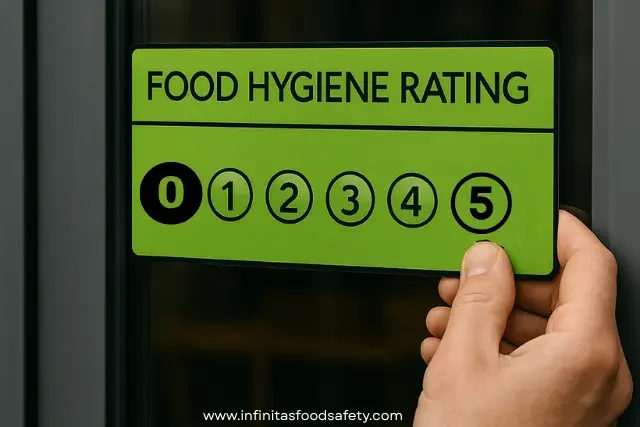
However, the 0 hygiene rating remains on display until the business has had a rescore. This means a business could be operating safely, but still has to display the dreaded 0 sticker at the door until the council returns for a reinspection (which can take weeks or months).
That’s why you sometimes see places trading with a 0 star food hygiene rating—confusing for customers, but perfectly legal under current rules.