When a food business receives a poor food hygiene rating, people naturally want to know what went wrong.
That was certainly the case when BBC Wales recently reported on the zero hygiene rating at Slim Chickens in St David’s Shopping Centre, Cardiff. The site had been downgraded from a food hygiene rating of 5 to 0 within around eight weeks.
A five means hygiene standards were very good at the time of inspection.
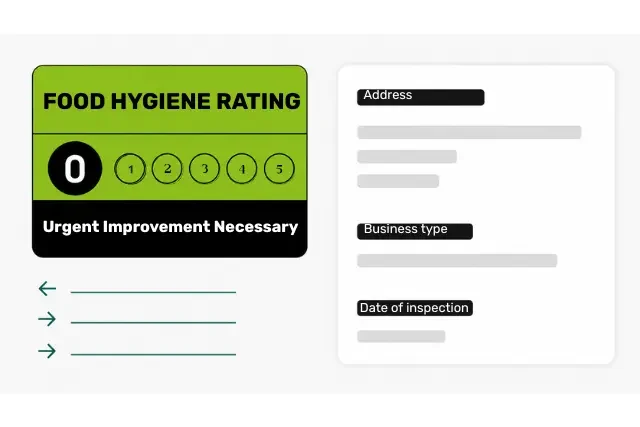
A zero means urgent improvement is necessary.
So when a business moves from one end of the scale to the other in such a short period of time, the obvious question is:
What happened?
And that is where things become less straightforward.
In this article, we explain how to get answers behind a low food hygiene rating, so you can make a more informed judgement about how safe the premises is.
Where to find the EHO inspection report for a low hygiene rating?
To start, you will need to go online to the Food Standards Agency’s food hygiene ratings database.
There you can search for the business name to find its current rating and the scores given for the three different areas assessed during the inspection.
But you will not see the environmental health officer’s inspection report.
That means you will be able to see the scores behind the final rating, but not the inspection findings that explain why those scores were awarded.
For someone trying to understand why a business received a poor rating, that can be frustrating.
Why is the food hygiene inspection report so difficult to access?
When you look up a business on the Food Standards Agency’s food hygiene ratings database, the inspection report is not linked to the rating.
You can see the rating and the individual scores behind it, but if you want to understand the inspection findings that led to those scores, you have to look elsewhere.
You will need to identify which local authority inspected the business, find the relevant council website and then work out how to request the information.
That is quite a journey from simply looking up a hygiene rating.
And many people, including consumers, may not even realise they can obtain the report.
You need to make a Freedom of Information request
The only way to obtain the inspection report is to request it from the local authority under the Freedom of Information Act.
That raises an interesting question in itself.
If the information behind a food hygiene rating is of genuine public interest, why does a consumer need to understand the Freedom of Information (FOI) process before they can see it?
For food safety professionals, journalists or particularly determined members of the public, making an FOI request may not seem difficult.
But would the average person know they could do this, or even how to do it?
Probably not.
How to request a food hygiene inspection report?
You need to identify the food business clearly and tell the council which inspection report you want.
To make that easier, we’ve prepared a simple Freedom of Information request template for you to use. You can copy it below and save it somewhere safe for future reference.
FOI request template
Subject: Freedom of Information Request – Food Hygiene Inspection Report
Dear Sir/Madam,
I am writing to make a Freedom of Information request for a copy of the food hygiene inspection report relating to:
Business name:
Business address:
Date of inspection, if known:
Food hygiene rating awarded:
I would also be grateful for copies of any notices issued to the business in connection with this inspection.
Kind regards,
[Your name]
You do not need to explain why you want the information.
Do you have to pay to get the food hygiene inspection report?
Normally, no.
For a straightforward request where documents can be supplied electronically, there would not usually be a charge.
That is useful to know because some consumers may assume that obtaining official inspection records comes with a fee.
How long does the council have to respond to your request?
Freedom of Information requests are not instant.
Public authorities would normally be expected to respond promptly and, in most cases, within 20 working days.
So even if everything goes smoothly, you could be waiting several weeks before you actually see the report.
That rather limits its usefulness if your immediate question is:
“Would I eat there tonight?”
What happens if parts of the report are redacted?
Some information may be removed before the report is released.
That does not necessarily mean anything unusual is being hidden.
Local authorities may need to remove personal information or other information that cannot legally be disclosed.
You may therefore receive a report with names, contact details or other information hidden..
The important point is whether enough of the inspection findings remain for you to understand why the rating was awarded.
Do all councils deal with inspection reports in the same way?
No.
And this is where things become particularly interesting.
Some councils have taken a much more transparent approach and publish considerably more inspection information online.
That means how easily you can understand the reasons behind a food hygiene rating can depend partly on where the food business is located.
Why do some councils publish inspection reports while others do not?
This is something I intend to explore further.
For example, Norwich City Council publishes food hygiene inspection reports for the public to see, with information anonymised where necessary.
That raises an important question.
If inspection reports can be made readily available to the public, why isn’t this happening everywhere?
And would greater transparency make the Food Hygiene Rating Scheme more useful to consumers?
Why is it so difficult to access the inspection report?
This is the question I keep coming back to.
The public clearly cares about food hygiene ratings.
There were almost 600 comments and over 100 shares on a Facebook post related to the drop in hygiene rating for Slim Chickens Cardiff.
When a business receives a zero rating, people want to know what happened, whether the problems were serious and why the business received that score.
The rating gives them part of the answer.
But the inspection report contains the information that explains why.
So if the purpose of the Food Hygiene Rating Scheme is to help consumers make informed choices about where to eat or shop, should finding that information really be this difficult to get hold of?
So, I decided to find out for myself...
I was recently asked to comment on a BBC Wales News article about Slim Chickens in Cardiff, after the premises was downgraded from a food hygiene rating of 5 to 0 within around eight weeks.
That made me curious.
So I decided to find out for myself how easy — or difficult — it is for a member of the public to obtain the actual inspection reports.
I’ve submitted a Freedom of Information request for both the April 2026 inspection, when the restaurant was awarded a 5, and the later inspection which resulted in a 0.
I want to see what the reports actually say — and, just as importantly, how straightforward the process is for an ordinary consumer who wants to understand why a rating changed so dramatically.
What happens next? To be continued….

Dr Julie Rasmussen
Need help understanding a food hygiene rating or EHO inspection?
Do you have any questions about a food hygiene rating?
Our online service Ask a Food Safety Expert provides clear, practical guidance, free of charge.
If you are struggling to navigate a recent inspection report or looking to protect your 5-star hygiene rating, speak with an expert food safety consultant near me today for practical, stress-free compliance advice.