Ghost kitchens—also known as dark kitchens or cloud kitchens—are reshaping food delivery in the UK. These delivery-only food businesses operate primarily through digital technology, with third-party apps like Deliveroo, Uber Eats, and Just Eat as the main platforms.
Yet with this innovation comes a new set of challenges. Concerns have been raised about the ability of local authorities to identify and regulate dark kitchens. Alongside growing health concerns around takeaway food in general, there is also doubt about the food safety standards of ghost kitchen operations—customers simply don’t know what goes on behind the scenes. This invisibility undermines perceptions of trustworthiness in the customer’s mind, no matter how strong your brand is.
In this post, we explore how operators can use forward-thinking digital tools—like QR codes—to turn food safety obscurity on its head and build lasting customer confidence.
Table of Contents
Why Invisibility is Still a Problem for Ghost Kitchens
Ghost, cloud or dark kitchens—whether run by well-known brands or independent operators—exist to meet the growing demand for food delivery. Yet even as the sector matures, the issue of invisibility remains.
The invisibility problem isn’t hypothetical — UK research shows most consumers are unfamiliar with ghost kitchens, with only about 25% having heard of them and many expressing concern about safety and hygiene. Importantly, the study found that consumers want more transparency about where and how their food is prepared. (Nield et al. 2025).
Unlike high street restaurants, customers never see ghost kitchens, their staff, or safety processes behind the meals they receive. For many, this hiddenness raises questions:
🔷 Are food hygiene standards being maintained behind closed doors?
🔷 Can I trust the food is handled safely?
🔷 What happens if something goes wrong?
Ghost Kitchens Lack Trust
According to recent research and a consumer study from the Food Standards Agency, lack of trust in food safety is one of the main barriers that prevent customers ordering from new or unfamiliar delivery brands.
“…trust in food hygiene ratings is high, but customers often don’t see these ratings when ordering online.” (Ipsos, 2024).
Leung et al. (2023) found that almost 70% of customers prefer ordering food from physical restaurants over ghost kitchens. Meanwhile Jiang et al. 2024 found that food safety is a core driver of initial trust with ghost kitchens, alongside perceived value, food authenticity and personalised experience. Higher initial trust increases the likelihood that customers will recommend and reorder.
This isn’t just a PR problem; it’s a risk to growth, reputation, and long-term sustainability. With so much at stake, ghost, cloud or dark kitchens need a way to stand out. By making food hygiene and a commitment to food safety as visible and credible as possible you create a competitive advantage.
Put simply, if customers can’t see your standards, they’re left to guess.
💡 A Solution To Ghost Kitchen Invisibility
To solve this invisibility problem, ghost kitchens, dark kitchens, cloud kitchens need a simple, reliable way to demonstrate high food safety standards in real time. This is where the Trust Passport comes in — bringing the most important food safety and food hygiene details out of the shadows and into the customer’s hands.
Ghost Kitchen Trust Passport
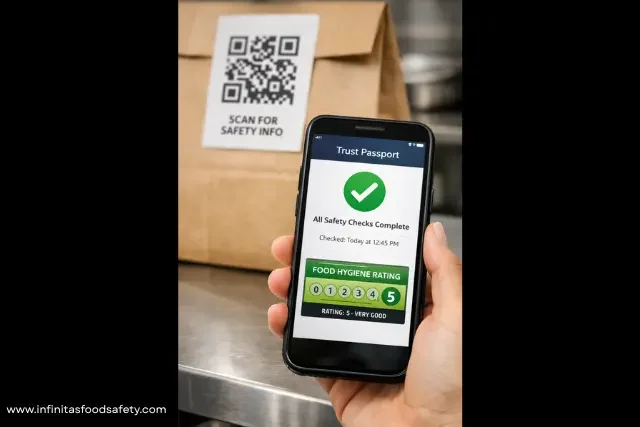
The Trust Passport is a unique Quick Response (QR) code—printed on every order—that links customers to a live, mobile-friendly page. It’s easy to fix to a wide variety of food packaging materials, such as cartons, corrugated, and cardboard boxes.
Instead of relying on a static hygiene rating or a generic promise, the QR code gives a transparent view of the safety controls in place at the very moment the food leaves the kitchen.
When a customer scans the code, they can see clear, up-to-date information such as:
📍Today’s food safety checks (with a recent timestamp)
📍Current Food Hygiene Rating, with a direct link to the official listing on the Food Standards Agency’s website
📍Confirmation that cold storage is within safe limits
📍Allergen controls and key ingredient information
Why Would a Trust Passport Work?
This approach could turn food safety compliance into a visible benefit. By sharing active data—simply and securely—you reassure customers at the most critical moment: when the order is delivered. Instead of relying on brand reputation alone, you provide real evidence of your food safety and hygiene standards.
Deloitte’s Future of Restaurants (2023) research finds that many consumers prefer placing orders through digital channels and see convenience and safety‑related features as key parts of the experience — underlining why real‑time, mobile‑friendly transparency tools like a QR code Trust Passport are relevant.
In a crowded and competitive market, the Trust Passport could make operators stand out for all the right reasons.
Learn more about using your hygiene rating as a marketing tactic. Or read about using your Food Hygiene Rating as a competitive advantage.
The Technology: Practical Steps for Operators
Bringing a Trust Passport system to life doesn’t require a huge investment or a complex IT overhaul. The key is to start with the essentials and build from there. Here’s how operators can get started:
1️⃣ Digital Food Safety Records
Replace paper checklists with a digital platform. Many affordable options let you log daily opening checks, fridge and freezer temperatures, cleaning routines, allergen controls, and corrective actions. The main goal: all checks are time-stamped and securely stored.
2️⃣ Temperature Monitoring
Begin with simple digital temperature probes or sensors. These make it easier to record and retrieve accurate data, and can alert you to issues before they become a problem. Over time, more advanced IoT sensors can be added to automate this process further.
3️⃣ Corrective Actions
Make sure any incidents—such as a fridge running warm or a missed allergen step—are logged alongside the actions taken. This shows a proactive approach and reassures both inspectors and customers that problems are managed, not hidden.
4️⃣ Generating the QR Code
Your compliance platform, or even a basic QR code generator, can create a unique code for each order or batch. The QR should link directly to a landing page displaying:
Today’s food safety checks (with timestamps)
Cold storage status (latest reading, within limits)
Your Food Hygiene Rating (with a link to the official site)
A short statement on allergen controls
5️⃣ Presenting the Information
Keep the landing page clean, clear, and jargon-free. Customers are looking for reassurance, not technical details. Visual indicators (like green ticks and timestamps) work well.
📌 Evidence To Support a QR Code Trust Passport Concept
A study by Rotsios et al. (2022) looked at the use of QR codes on bottled milk packaging, where consumers were directed to a webpage after scanning the code. The researchers found that:
A significant portion of consumers scanned the QR code and accessed the linked website.
After scanning, consumers reported higher perceived knowledge of the product — meaning the QR code gave them more confidence and understanding about what they were buying.
QR codes enabled businesses to provide timely and accurate information and positively influenced buying behaviour, including intention to use the product.
In simple terms, this research shows QR codes on food packaging can increase consumer confidence and engagement, which directly supports the Trust Passport concept: turning invisible processes into visible, trusted data.
Avoiding Common Mistakes With QR Code Safety
Even with the best technology, there are a few key pitfalls ghost kitchens should avoid:
✅Don’t rely on the Food Hygiene Rating alone
Linking your QR code to your Food Hygiene Rating is valuable—by linking to the Food Standards Agency website, you give customers instant access to the official, trusted score. But remember, the rating is only a static snapshot. To truly build trust, your QR code should present up-to-date, real-time safety data.
✅ Verifiable QR codes could help reduce the risk of food fraud and hygiene rating counterfeiting (Li et al., 2024). This is a growing problem in the hospitality industry. Check out our previous post on fake food hygiene rating stickers.
✅Avoid information overload
Stick to simple, clear status updates. Customers want reassurance, not reams of technical data. Use plain English, visual cues (like ticks and timestamps), and keep it user-friendly.
✅Keep your records accurate
If you’re sharing data publicly, your underlying records need to be reliable, consistent, and audit-ready. Mistakes or inconsistencies undermine confidence—and can cause trouble in an official inspection.
✅Ensure data privacy
Only display what’s necessary for customer reassurance. Avoid including any personal or staff information, and make sure your process complies with data protection rules.
Future Trends and Opportunities
Looking ahead, trust and transparency will only become more important for ghost kitchens and delivery brands. Regulations are evolving, with a growing focus on digital product passports and clearer consumer information. Operators who act now—making safety and quality visible—will be best placed to benefit as expectations rise.
Collaboration is also key. No single business or technology can solve this alone. The strongest results will come from operators, software providers, and even investors working together to set new standards.
Conclusion
The days of operating “in the dark” are numbered. The Trust Passport could offer a practical, affordable, transparent way for ghost and dark kitchens to show exactly how they manage food safety—turning a traditional weakness into a real competitive strength. When customers can see your food safety standards, there’s nothing left to guess. Make your food safety standards visible today!
Book your free call to get started.
📞 02920 026 566
✉️ [email protected]

Dr Julie Rasmussen
References & Further Reading
Deloitte. (2023). The future of restaurants: The new normal and beyond (4th annual survey). Deloitte Development LLC. Retrieved from https://www.deloitte.com/content/dam/assets-shared/docs/industries/consumer/2024/the-future-of-restaurants-2023.pdf
Ipsos. (2024). Understanding consumer needs in relation to food hygiene ratings in an online food ordering environment. FSA Research and Evidence. Retrieved from https://doi.org/10.46756/001c.123520
Li, P., Yang, J., Jiménez‑Carvelo, A. M., & Erasmus, S. W. (2024). Applications of food packaging quick response codes in information transmission toward food supply chain integrity. Trends in Food Science & Technology, 146, 104384.
Nield, L., Martin, H., Wall, C., Pearce, J., Rundle, R., Bowles, S., Harness, D., & Beaumont, J. D. (2025). Consumer knowledge of and engagement with traditional takeaway and dark kitchen food outlets. NIHR Open Research, 4, 64.
Rotsios, K., Konstantoglou, A., Folinas, D., Fotiadis, T., Hatzithomas, L. & Boutsouki, C. (2022). Evaluating the Use of QR Codes on Food Products. Sustainability, 14(8), 44