
Wales is introducing big changes to the way the food hygiene inspection frequency is decided for businesses. Most food business owners are unaware of the new enforcement policy or how it could affect their next visit from the local authority inspector. If you run a food business, here’s what’s changing, why the food hygiene rating scheme rules have been updated, what it means for your inspection rating, your risk category, and how often you’ll receive an in-person hygiene inspection in future.
Table of Contents
New Changes to Food Hygiene Inspections in Wales - How Will it Affect Your Business?
As of October 2025, the Food Law Code of Practice (Wales) has introduced major updates to the food hygiene inspection system:
Local councils can now send Food Safety Officers—not just Environmental Health Officers (EHOs)—to inspect and rate lower-risk food businesses.
High-risk, complex, or non-compliant businesses will still be inspected by fully qualified EHOs.
Routine inspections for cafés, retailers, takeaways, and similar premises may now be carried out by someone who isn’t an EHO, but has received in-house training and passed a local competency assessment.
As New Food Magazine reported, the key changes of this modernisation agenda:
“….include a more flexible approach to prioritising checks on new food businesses, with local councils able to triage operators when they first register. Councils will also be able to make greater use of alternative methods, such as remote assessments, to target resources more efficiently.
The updated Codes also broaden the range of professionals who can undertake certain official control activities in England and Wales, ensuring officers’ expertise is dedicated to where it can have the greatest impact.
If your business is used to seeing an EHO at every inspection, don’t be surprised if your next inspection report comes from a Food Safety Officer or someone with a different background. The changes are designed to better target risk and public health priorities, making enforcement more flexible.
Why Has a New Approach To Food Hygiene Inspections Been Introduced?
The reason for these changes is simple: resources. Local authorities are facing ongoing staff shortages and tighter budgets, which is putting pressure on public health and enforcement.
To keep the food hygiene rating scheme running, councils have had to adapt their enforcement policy—doing more inspections with fewer fully qualified EHOs.
🔷 Councils now have fewer EHOs than ever before, so inspections of lower-risk businesses are being carried out by food safety officers with in-house training and local competency sign-off.
🔷 EHOs are now reserved for the most complex risks or poor ratings. Everyone else is triaged and may be seen by a less qualified officer.
🔷 Alternative methods are increasing: If your business consistently gets a rating of 3 or higher, you could get a remote assessment or just a telephone call instead of a full in-person visit. This is to make better use of resources and target higher risks.
🔷 The public isn’t told this, but the reality behind the new approach isn’t about raising standards—it’s about keeping the system working when resources are at breaking point.
The Senedd Report 2024
The 2024 Senedd report reviewing the Food Law Code of Practice for Wales confirmed that these changes aim to help councils “recruit, train and deploy additional officers” and tackle ongoing resource pressures following Brexit and the pandemic.
(Food Standards Agency 2024, The Senedd Report, paragraph 6.16, page 20).
The scale of the problem is clear. Legal expert Zoe Betts of Pinsent Masons points to the latest FSA “Our Food 2024” inspection report, which found around 95,000 overdue food inspections across England, Wales, and Northern Ireland—including 871 high‑risk businesses—in just six months. As Betts warns:
“To be effective, a regulator must be adequately resourced; otherwise the door is open to bad actors.”
(Betts, Z, FSA Report raises red flags over Local Authority resourcing, Pinsent Masons, 2024).
Under-resourcing directly affects the ability to uphold food hygiene law and protect public health, increasing the risk of problems being missed in food businesses.
Food Hygiene Rating Scheme - A New Scoring System
Although the 2024 Senedd report stated there were no changes to the Food Hygiene Rating Scheme scoring system at that time, this has now changed. With the new Food Law Code of Practice released in October 2025, Wales has adopted an updated rating scale, bringing it in line with changes in England and Northern Ireland.
The new scoring system and decision matrix:
🔷 Sets out revised criteria for rating food businesses, with a stronger emphasis on risk-based approaches and more flexibility in inspection methods.
🔷 Introduces a standalone score for a new ‘allergen risk factor’ and new inspection frequencies.
🔷 Requires businesses to keep their food safety management system up to date to meet the new criteria.
This marks an important shift in how inspection reports are produced and how hygiene regulations are enforced. Let’s break down what this means for you.
The Old Food Hygiene Rating Inspection Frequency
Under the old food hygiene rating scheme, every business in the same category had the same inspection frequency, regardless of their actual performance or inspection rating.
🔷 Whether your business had a rating of 0, 1, 2, 3, 4, or 5, your food hygiene inspection frequency was set only by your risk category.
🔷 For example, Category C businesses (such as restaurants and takeaways) were inspected every 18 months—no matter if they had a poor rating (like 1 or 2) or a top rating (5).
🔷 Low performers were treated on the same timetable as the best performers, unless the food safety management system or business type changed.
The New Food Hygiene Rating Inspection Frequency
With the new rating scale and Code of Practice, this has changed. Now, if you’re a Category C business (e.g. restaurant or takeaway) and you’re not meeting the minimum standard—broadly compliant (3)—and you have a poor rating (2 or below), you’ll be on the radar for more frequent, in-person inspections.
🔷 Low-rated businesses will now trigger quicker, more frequent face-to-face inspections—no more slipping under the radar.
🔷 Local authorities will focus limited resources where there is highest risk and compliance isn’t improving.
🔷 If you maintain good food hygiene standards, you could go up to 5 years (60 months) without an in-person inspection—just a phone call, online survey, paperwork check, or a virtual inspection. (See Food Law Practice Guidance Wales, Oct 2025).
Businesses With A Poor Hygiene Rating Will Receive More Frequent Food Hygiene Inspections
Authorities are under pressure to protect public health. They will inspect poor performers more often, and concentrate on businesses where standards aren’t improving. Good performers will have fewer in-person visits. Struggling businesses will see more attention, more face-to-face food hygiene inspections, and more follow-ups in their inspection reports—until standards meet the required hygiene regulations.
Is This Good for Food Safety Enforcement?
Not everyone is comfortable with these changes to food safety enforcement. There’s real concern about allowing non-EHO officers to inspect lower-risk businesses.
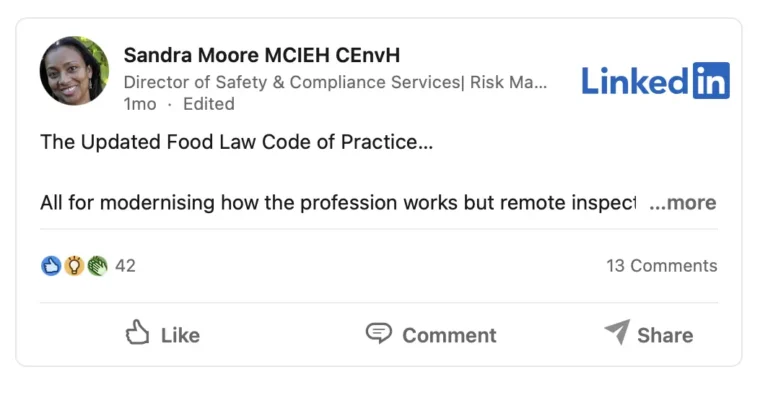
🔷 Sandra Moore commented on LinkedIn (October 2025):
“Would you knowingly have someone who isn’t medically qualified tend to your healthcare needs? So why are we accepting less in food safety?”
It’s a fair question. The public assumes that food inspectors have specialist expertise—just as we expect from a doctor or nurse.
This isn’t unique to food safety. I saw exactly the same thing when I worked in the NHS and studied patient safety. In 2013, as doctor shortages hit, the NHS trained Advanced Nurse Practitioners to take on work previously done by GPs. The change was described as “modernisation” and “flexibility”—but inside the system, everyone knew it was because there simply weren’t enough doctors. Roles shifted, and nurses picked up more responsibility to keep services afloat.
Now, we’re seeing a similar shift in food safety enforcement—a response to staff shortages and budget cuts. Whether this approach can protect public health and keep standards high remains to be seen. The risk is inconsistency, less experienced officers producing inspection reports, and a gap between what the public expects and what’s really happening behind the scenes.
Final Words - Why You Need To Stay Updated
Wales has now joined England and Northern Ireland in adopting a more risk-based and flexible approach to food hygiene inspections. The days of routine, in-person visits for every business are over. For some, this means fewer disruptions and less frequent inspections. But if your business has a poor hygiene rating, expect more scrutiny and more face-to-face visits—along with increased costs, as food enforcement is now run on a cost recovery model.
If you’re unsure where you stand, or you want to make sure your business is inspection-ready, get in touch for a confidential chat or book a mock inspection. Call us on 02920 026 566 or email: [email protected]
Change is here, whether we like it or not. Those who keep one step ahead will be the ones who thrive.
