Not sure where to begin with food safety? You’re not alone. Running a food business today means juggling changing rules, never‑ending paperwork, and the constant pressure of inspections and food hygiene ratings. Even the best-run businesses need a little support —whether it’s practical advice, step-by-step guides, or just a friendly expert to answer your questions.
That’s why we created the Infinitas Food Safety Help Centre. Here, you’ll find clear answers and expert guidance on everything from HACCP and food hygiene inspections, to allergens, complaints, and building a positive food safety culture.
You’re in the right place.
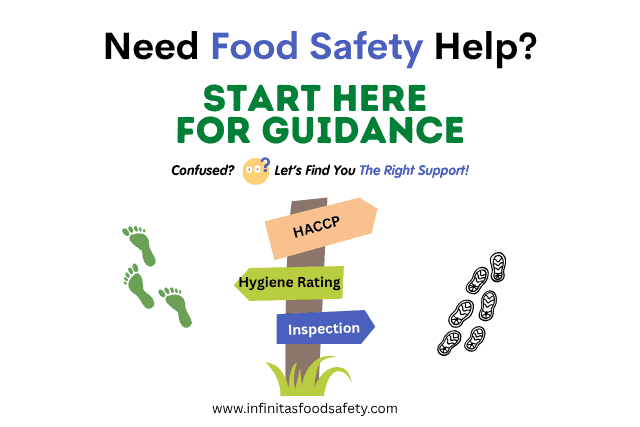
This page is your signpost. Check the contents list below and click on the topic that matches your problem. We are adding new topics weekly.
Table of Contents
Register a Food Business
Before you can legally trade, every food business in the UK must register with their local authority. Registration is quick, free, and usually needs to be done at least 28 days before opening. You’ll need to give basic details about your business and the food you handle.
Use this link to register a food business on the Food Standards Agency website.
Avoid the common mistake many new business owners make after registering their business. Read this short guide as it outlines a major error and how to avoid it.
And if you are selling food online this is a must read: Register a Food Business (UK): The Social Selling Blind Spot.
If you are setting a new food business or a ghost kitchen/dark kitchen, and you are unsure about the registration process, or want help getting it right first time, contact us for friendly support.
Email us at: [email protected] or use our Ask An Expert form to send us a food safety question. We’ll respond within 48 hours.
Food Safety Management (HACCP & Compliance)
Every UK food business needs a food safety management system—whether you use Safer Food, Better Business (SFBB), a HACCP plan, or another approach. Keeping your paperwork up to date is essential for passing inspections, protecting your customers and complying with the law.
For step-by-step help reviewing your HACCP or improving your paperwork, see our HACCP Review Guide.
If you want 1-1 personal support, contact us for expert advice with a human touch. Any solution we offer you will be tailored to the challenges you are facing.
For Email Queries: [email protected]
To speak to a human call our office landline is: 02920 025 566.
EHO Inspections – Prepare To Pass
Every food business is inspected by an Environmental Health Officer (EHO) to make sure you meet legal food safety standards. Inspections can be stressful, but with the right preparation you can avoid common mistakes and feel more confident when the EHO arrives.
For a practical checklist and insider tips on what to expect and how to prepare for a 5 star hygiene rating, see our EHO Inspection Guide. Find out why using a checklist is the key to preparing for your next inspection.
Other useful posts to help you prepare for your food safety inspection include:
🔷 How to Pass a Food Hygiene Inspection: A Smarter Approach
🔷 After A Food Safety Inspection: What Smart Businesses Do Next
🔷 How To Get a 5 Star Hygiene Rating When Rebranding
🔷Reframing EHO Inspections: Turn Fear into Focus
If you want a mock EHO inspection or tailored support for your team, contact us for a chat.
Food Hygiene Rating – How It Works
Your food hygiene rating can make or break your business reputation. When your business is inspected and assessed for a food hygiene rating 3 key factors will be taken into account. Even small issues can bring your hygiene rating score down, so understanding what inspectors look for is key.
If your business has received a low score, don’t panic. There are clear steps you can take to recover, improve your rating, and protect your reputation.
For a breakdown of what each rating means and what to do if your score is low, see our Food Hygiene Ratings Guide.
🛑 Be aware that the approach to food hygiene inspections is changing. Find out what to expect and what is changing by reading our new post below:
🔷 Food Hygiene Inspections Frequencies Are Changing (Wales) – What To Expect? [Updated Oct 2025]
Other related posts you might find useful related to food hygiene ratings and inspections:
🔷 Zero Food Hygiene Rating: Legal Notices Served
🔷 Got a 1-Star Hygiene Rating? Here’s How to Protect Your Reputation Now
🔷 Hygiene Rating Sticker: UK Display Rules Explained (2026)
If you want expert support to boost the systems, knowledge and behaviours in your business so that you can achieve a 5 food hygiene rating, contact us on: [email protected]
To speak to a human. Call our office: 02920 025 566.
Food Hygiene Appeals & Re-Ratings
If you believe your food hygiene rating is unfair or incorrect, you have the right to appeal the decision. An appeal asks the local authority to review your case and the inspection findings—it may involve a new visit from a different officer.
Once you’ve made improvements after a low score, you can also request a formal re-inspection (known as a revisit) to be re-rated.
For clear steps on appealing your food hygiene rating or requesting a re-inspection, see our guides below:
🔷 Food Hygiene Rating Scheme (FHRS) Appeals – What Is The Problem? (PART 1)
🔷 Appeal A 1-Star Hygiene Rating – Complete FAQ Guide (PART 2)
🔷 How to Appeal a Food Hygiene Rating With AI (PART 3)
If you’d like help preparing your appeal or planning for a revisit, contact us for expert advice. Send us an email: [email protected]
Allergen Management, Natasha’s Law & The Out-of-Home Sector Guidance
Keeping customers safe from allergens is a vital part of food safety. Under Natasha’s law, clear labelling requirements are in place for foods known as PPDS food. All staff need to know how to handle allergen requests from customers confidently. Mistakes can be life-threatening and lead to serious legal consequences.
The Food Standards Agency has also updated its allergen guidance for non-PPDS food. For practical steps on managing allergens and understanding Natasha’s Law, see our Allergen Management Guide.
To find out about allergen management in schools read:
How Safe Is Your School’s Approach to Food Allergies in the UK?
Food Hygiene Ratings in Schools: Hidden Failures in Wales.
If you need tailored advice, multi-language training, or want to review your allergen procedures, contact us for support. Email us: [email protected]
Food Safety Culture
Food safety isn’t just about the documentation—it’s about the daily habits, attitudes, and behaviours of everyone on your team. Creating a strong food safety culture means making safe practices second nature. And building trust from the kitchen to the front door.
If you want to strengthen your food safety culture so that it supports your business then our Food Safety Culture Guide (coming soon) will show you how.
If you’re looking for answers following a disappointing food hygiene inspection, start by reading: Food Hygiene Rating Crisis? What To Do When Your Hair’s On Fire
Getting staff to follow the rules can be frustrating. If you want to influence behaviour read the following posts:
🔷 Food Safety Compliance: Closing Gaps With Behavioural Science
🔷 Why Hand Hygiene Compliance Among Food Service Workers Still Fails in 2025
🔷 How To Break The Chain of Infection in Food Safety
🔷 Food Safety Compliance: Are There Holes in Your Defences?
For practical support, bite-size training, or food safety compliance mentoring, contact us to learn more.
If you feel stuck: Email us: [email protected]
Telephone us: 02920 025 566.
Food Poisoning, Complaints & Crisis Management
No food business is immune from complaints or food poisoning incidents. Even establishments run by Michelin chefs have food hygiene failures and poor hygiene rating scores.
How you respond and learn from incidents can make all the difference to your reputation and your customers’ safety. Acting quickly, communicating clearly, and knowing your responsibilities will help you handle any crisis with confidence.
For advice on managing food safety complaints, food poisoning claims, or a food poisoning outbreak, see our Food Poisoning & Crisis Management Guide (coming soon).
You may also like to read our post about food handlers as carriers of infection: Typhoid Mary: The Invisible Risk of Asymptomatic Carriers in Food Handlers.
If you need urgent support to manage your response in a crisis, contact us on: 02920 026 566
Ask an Expert – Free Food Safety Helpline
Sometimes you just need a quick answer or some friendly human reassurance about a food safety question or concern. Our Food Safety Helpline connects you directly to an expert—no jargon, no judgement, just practical advice when you need it. It’s a free service.
Alternatively, read our post about the Ask an Expert Helpline. It includes a link to get in touch if you need to.
We aim to respond within 48 hours with clear, straightforward answers to your food safety questions.
EHO Powers & Regulatory Challenges
Worried about an unannounced visit from an Environmental Health Officer? Learn about the EHO’s legal powers, what to expect if they turn up unexpectedly, your rights and responsibilities, and how to handle crisis situations calmly and professionally.
Let’s start with the EHO power of entry. It’s important to understand why prevention beats cure every time.
Food Safety Compliance
Understanding the rules is one thing. Complying with them consistently — especially when no one is watching — is another. This section gives you simple, research-backed tips to turn compliance into habits for everyday behaviour.
Most compliance advice sits behind paywalls or in dense research cabinets. Here, we’ll bring this evidence to life in ways you can use on in your business for everyday compliance.
① Make the right behaviours easier to do
Research in behavioural science shows that ease matters. If a task is complex or not perceived to be relevant, people will workaround it. Read our guide about Closing the Gaps with Behavioural Science.
② Prompt, don’t nag
Prompts (like handwashing signs placed right at the sink) work because they catch attention exactly when the behaviour is needed. Evidence shows that prompts are especially effective in busy kitchens where staff are time-pressed. Read our post to find out what can be done to improve Hand Washing Compliance.
③ Tie compliance to your business outcomes
Stories engage people more than rules. So when you talk about why something matters — like how poor hygiene led to outbreaks historically — people take notice. Real cases like Typhoid Mary aren’t just history: they remind us that invisible risks of infected food handlers have visible consequences.
④ Measure what you care about — and share the results
Collect simple data (e.g., handwashing observations) and share it frequently. Teams engaged with results are more likely to sustain good practice. Focus on small wins — like improving by 10% compliance this week — to build momentum.
If you need tailored site specific advice, contact us for support. Email us: [email protected]
Food Safety Marketing
Customers aren’t just buying food — they’re buying confidence. People check hygiene ratings and your online presence before they choose where to eat or buy food. Use what you already know and do in food safety to shape how your business is seen online and in person.
① Use Your Hygiene Rating Where It Counts
Too many operators display their rating on a window or door and forget about it. Your hygiene rating is a trust signal — so put it in the places your customers will actually see:
Website header or homepage
Google Business Profile and other listings
Social media profiles and posts
Learn more about using your hygiene rating as a marketing tactic.
② Build Your Online Presence Beyond Social Media
Relying only on a Facebook page isn’t enough. Most customers start searching on Google, not social apps — and a proper website gives you an added advantage. If you’re invisible on Google, you lose customers before they even see what you’re about. Use your food safety to stand out and build trust in 2026.
③ Make Food Safety Part of Your Story
Talking about what you do differently — your training, checks, cleaning routines, allergen handling — helps people understand your standards. Customers don’t just want safe food — they want confidence in your process.
④ Be Ready for New Laws — and Use Them Positively
New food promotion laws in Wales (comes into effect in March 2026) will mean changes in how products are advertised and displayed. If you approach these proactively, you can build more trust and loyalty with health conscious customers.
⑤ Encourage Trust in Every Touchpoint
Ask customers to mention hygiene and safety in reviews.
Talk about food safety improvements in newsletters or menus.
Use badges, icons, and clear wording so people don’t have to guess what you’ve done.
Use QR codes on food packaging to increase customer confidence.
More Support & Resources
Looking for more advice or practical tools? We’re adding new food safety topics, step-by-step guides, and free resources every week—so check back often!
Here are some other useful links:
🔷 Ask an Expert – Free Helpline
🔷 Why hire a food safety consultant?
🔷 How-To Guides & Video Tutorials (includes downloadable checklists)
🔷 Visit our Food Safety Blog
Can’t find what you’re looking for? Just get in touch—we’re here to help.
Check out our services: Infinitas Food Safety – What We Offer.
If still unsure get in touch:
Email us: [email protected] or call the Infinitas Team: 02920 025 566.
