A big change is coming to food businesses in Wales from March 2026. New rules will control how certain foods are promoted and displayed — not just in large supermarkets, but in large food and drink retailers, restaurants, and takeaway chains.
These changes are rooted in behavioural science, and use nudge theory to help people make healthier choices. Diet is a leading cause of ill health in Wales. By focusing on prevention (rather than cure), the goal is to reduce pressure on the NHS. The annual cost of obesity in Wales is an estimated £3 billion.
Find out the key changes and what they mean for your business.
Table of Contents
Q1: What’s the new law about❓
The Food (Promotion and Presentation) (Wales) Regulations 2025 will restrict the promotion and presentation of foods high in fat, salt, and sugar (HFSS) in Wales for medium and large retailers (50+ employees).
Businesses will be restricted in where HFSS products can be positioned in prominent places, both in-store and online (e.g. websites). The regulations also ban volume-based price promotions like “buy one get one free” and “3 for 2” offers, and prohibit free refills on sugary soft drinks.
Q2: Why are the new rules being introduced❓
Our food environment has developed in a way which prioritises convenience over health. This includes a focus on easy, quick foods that are often energy-dense and high in fat and sugar (less healthy foods). Affordability and positioning in a retail environment encourages impulse purchases likely to result in excess calories and weight gain.
These regulations aim to encourage healthier choices by making healthier products more visible and available, for children and adults, by:
🔷prohibiting businesses from putting these foods in the most tempting places — like at the end of aisles, by tills, or at shop entrances.
🔷bringing in similar rules for online banners and pop-up offers for HFSS foods.
Q3: What type of businesses does this new law apply to❓
The new law applies to large food businesses in Wales with 50 or more employees, but there’s an important difference between company-owned chains and franchises:
🔷Company-owned chains: If you work for a business where all shops, restaurants, or cafés are run by one company (like Starbucks or Greggs), the employee count is added up across all sites in Wales. If there are 50 or more employees in total, the rules apply to every location, even if some branches are small.
🔷Franchise chains: If each shop or café is owned by a different franchisee (so each one is a separate business), the law usually looks at the number of employees in each individual franchise. If a franchise has fewer than 50 staff, the rules normally do not apply to that outlet.
However, if all staff are managed as one group by the franchisor, or the contracts mean they are counted together, the law might apply. If in doubt, check your contract or speak to your head office.
Q4: Are there any exceptions❓
Businesses selling food and drink are exempt from the volume price promotions include, but must comply with the restrictions on the free refills promotion of certain drinks.
These include:
✅Micro or small businesses (under 50 employees)
✅Care homes, hospitals, and education institutions
✅Restaurants (including cafés, coffee shops, fast food or takeaway businesses)
✅Food provided by a charity as part of its charitable activities.
Q5: Why is this law taking away freedom of choice❓
This legislation does not stop people from buying these products. Instead it limits how they are marketed and where they are placed within stores, such as near checkouts. The effect on “freedom of choice” will remain intact.
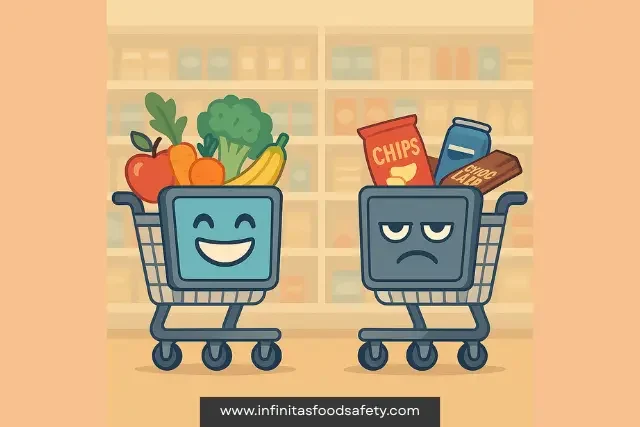
Nudges will give people a gentle push towards making better choices (buying healthier food and drink), without banning things completely. For example:
① By putting fruit and healthy snacks in places where people will see them first, or making less healthy food less visible.
② Making the healthy choice the easier choice.
③ These new Welsh rules intend to alter public behaviour on a mass scale by changing the environment (what’s on offer, where foods are displayed in shops, and how promotion deals are run).
Nudges are frequently used in other areas of public health policy to encourage safer driving behaviour, tobacco and alcohol prevention, organ donation, and weight loss.
Q6: Have other countries tried this approach, and does it work❓
Yes, other countries have brought in similar rules based on nudge theory — and the results are mixed, but promising.
📍England: Similar rules came in during 2022, with more on the way. Early evidence shows that when shops stop promoting high fat, sugar, and salt foods in the best spots, people buy less of them.
📍The Netherlands: Studies there tested moving healthier foods to places where people see them first (like at checkouts), or adding special offers for healthy items instead of unhealthy ones. They found that “nudging” shoppers towards healthy food can help a bit — but this works best when combined with better prices for healthier options too.
💡 The takeaway: Changing how food is promoted and where it’s placed does make a difference, but it’s not a magic fix. For best results, it needs to be part of a wider intervention to make healthy eating easy and more appealing.
Q7: What are the pros and cons for food businesses❓
PROS
✅ Your business will be following the law and avoiding future fines by complying with the legislation.
✅ You could boost your reputation by showing customers you support healthy choices.
✅ These changes can help you stand out if you get creative with new, healthier offers.
…food safety isn’t just a legal requirement — it’s a competitive advantage for food businesses. If you want to explore further how you can use your hygiene rating and safety standards to build trust and attract more customers, check out our in‑depth post on “Food Safety as a Competitive Advantage.”
CONS
❌ You may lose some quick sales from popular deals on snacks and treats that are now restricted.
❌ There will be work involved in changing your displays, signage, and website banner offers.
❌ Some customers might be confused or unhappy at first if their favourite deals disappear.
❌ The cost of implementing the new law means that businesses will likely transfer the cost onto the consumer via the price of food products.
❌ Trading standards officers will issue improvement notices first. If the rules are not followed, you could face a fixed fine of up to £2,500.
Final Thoughts
The new law is a big shift for supermarkets and other large retail food businesses in Wales.
The aim is to make it easier for everyone to choose healthier options and reduce the pressure on the NHS from obesity. Whilst there is evidence that social nudging works, the cost of food will likely increase as businesses pass on the cost of implementing the rules to customers. This may disproportionately affect people on lower incomes, although the Welsh Government’s goal is to reduce health inequalities.
As the implementation date approaches, keep an eye out for updates and further guidance from the Welsh Government and industry bodies. Staying informed will help your business prepare for the changes ahead.
