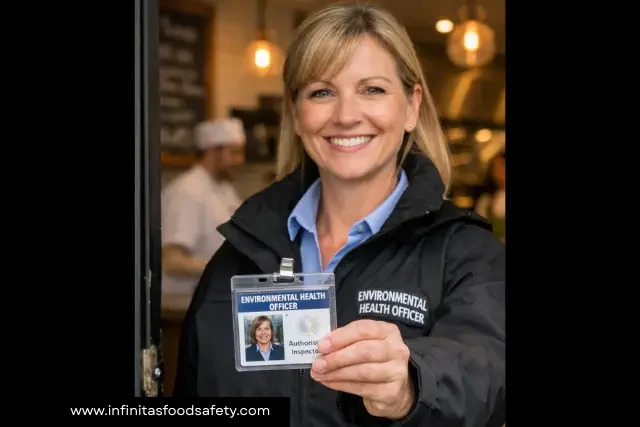
If an Environmental Health Officer turned up unannounced at your business right now… would you freeze?
Do you actually know your rights — and, just as importantly, the EHO’s legal power of entry?
In this guide, I’ll break down what “right of entry” means for UK food businesses, when a warrant might come into play, and what refusing access can trigger — so you can handle that doorstep moment calmly, and keep your team confident.
Table of Contents
Powers of an Environmental Health Officer
Environmental Health Officers are given wide ranging powers to enforce public health legislation. You may know their role by a different name.
They are often called 🔷Environmental Health Practitioners 🔷Environmental Health Inspectors 🔷Environmental Health Officer Food Safety 🔷Food Inspectors 🔷Health Officers 🔷 Food Hygiene Inspector.
Commonly, their title is shortened to EHO.
EHOs working in food safety are given legal powers under UK food law. The most important — and often the most misunderstood — is the right of entry into your food business. EHOs can also check records, take food samples, serve legal notices, and, if there is an imminent risk to public health, seize food or equipment and even close your business using a Hygiene Emergency Prohibition Notice. They may also decide to prosecute.
But it’s the right of entry that causes most anxiety. So in this article, we’ll focus on the EHO power of entry. I’ll explain how it works through a story.
When The Health Inspector Calls
It’s 11:20 on a Tuesday.
The food delivery driver has just turned up early, the phone won’t stop ringing, and the kitchen’s doing that frantic little dance where everyone looks busy because, let’s face it — everyone is busy. Someone’s shouting for more clean trays. Front of house is hunting for the allergen folder that was “definitely right there yesterday”.
Suddenly, one of your team appears at the pass, eyes wide.
“Erm… there’s an Environmental Health Inspector here.”
You can almost feel the temperature shift. It’s one of those hair on fire moments. Not because someone’s done something wrong. But because an unannounced EHO visit always lands at the worst possible time.
It’s human nature to want to buy time. Tidy up. Take a breath. Check the paperwork. Call the boss.
No one wants their chaos on display, do they.
Greeting the Inspector: Calm or Chaos?
You step out, wipe your hands, and greet the officer.
She is polite. Matter-of-fact. Professional. But this somehow makes you feel even more frantic.
The inspector introduces herself, and asks for the person in charge. There’s no drama – no “we’ve had a complaint.”
Just quietly, “I’m here to inspect your kitchen.”
Tip💡 Train your team on how to survive an EHO inspection: know the behavioural moves that matter.
To Delay or Let Them In?
At this point, there’s a choice.
Part of you wants to say:
“Can you come back later? We’re slammed.”
Or: “We don’t do walk-ins.” 🤣
Or: “The manager isn’t here.”
Instead, you say something softer — “Can you give us ten minutes?” or “Now really isn’t a good time.”
Honestly? I get it. You’re not being awkward. You’re just trying to keep things under control, avoid embarrassment, and maybe buy time to get things looking a bit less… lived in.
Why Refusing Entry Might Not End Well
If you start trying to control the officer’s visit by blocking access, you risk turning a routine hygiene inspection into a situation 😨
Not because food inspectors are out for a fight. Most just want to get on with their job. But because food law is complex.
And the EHO, with all their powers, has a job to do ensuring that your business is complying with legal requirements.
The Moment of Decision
So the officer calmly repeats their request. They need to come in and carry out a food hygiene inspection.
Now your brain is racing:
What’s out of date? Where’s the cleaning schedule? Did anyone sign the fridge temps? Is the diary up to date? Did we stock the handwash sink?
You glance at your team and see the panic rising, like steam.
Two Real Choices
You can:
-
Let the environmental health inspector in and handle it professionally. It’s never convenient, but it’s the right move.
-
Block, delay, or debate. And set off a chain of events that, honestly, will never work out better.
This is just a story. But it mirrors the tension that happens every day. The way to deal with this is to be prepared. And that’s why you need to know the facts.
Do Environmental Health Officers Have Right of Entry?
Yes — in the UK, authorised food officers (often EHOs) have legal powers of entry, so they can enter food premises to carry out official checks and enforce food law. For most food businesses, that means an officer can turn up unannounced and request entry at all reasonable hours.
What that means in plain English:
-
They can enter premises used for a food business. That’s a broad term — it can include kitchens, storage areas, market stalls, and vehicles used for food business activities.
-
They must carry ID. If you’re unsure who they are, it’s reasonable to ask for identification/authorisation before you let them into back-of-house areas.
-
Private homes have extra protection. If a place is used only as a private dwelling, the rules are different and officers won’t usually just “turn up” in the same way.
-
If entry is refused, they can apply for a warrant. A magistrate can authorise entry (and, if necessary, reasonable force, which means that they can bring allow the police).
-
Blocking access can become its own problem. Obstructing an authorised officer can escalate matters fast.
Obstructing An Authorised Officer
Do EHOs Need a Warrant?
An authorised officer in the UK can enter your food premises at any reasonable hours to carry out official checks without a warrant.
A warrant may be used when normal entry doesn’t happen, for example:
🔷Entry is refused (or the officer expects to be refused).
🔷The premises are unoccupied and urgent access is needed.
🔷The officer has reasonable grounds to believe that waiting or giving notice would defeat the purpose of the visit.
If those tests are met, a court can issue a warrant authorising entry, and it can allow entry using reasonable force if necessary.
When An Appointment May Be Made
There are certain situations where the food inspector or EHO is unlikely to turn up unannounced:
Home-based businesses: where there’s a private dwelling element, officers will often arrange an appointment so the right person is there and access is appropriate.
Manufacturing / night operations: if an officer knows you work late or run night shifts, they’re often more likely to agree a time so the inspection is effective and safe.
An appointment is common — but it’s not the same as “they have no right to enter”. It’s usually about practicality, safety, and making the visit meaningful.
What Happens If You Refuse Entry?
People refuse or delay entry for all sorts of human reasons: panic, not knowing the rules, fear of “being caught out”, or simply because it’s the worst possible moment. But in food enforcement, refusing access is rarely a neutral move.
Here’s what can happen (realistically):
✅ The officer won’t just go away. They’ll usually note the refusal and decide what the next step needs to be.
✅ It can quickly become a legal issue. Deliberately obstructing an authorised officer acting under food law can become a problem in its own right.
✅ A warrant is an option. If entry is refused (or expected to be refused), the officer can apply for a warrant to enter, which may allow entry using reasonable force.
✅ It can change the tone of the relationship. Even if your standards are good, refusal can reduce trust and increase scrutiny.
When The Timing is Genuinely Impossible
If the timing is not good, don’t refuse entry — handle it professionally.
Sometimes there will be a legitimate reason where you can’t host an inspection that minute (for example, an active safety incident or a genuine emergency).
If that’s the case:
📍 Explain the specific reason clearly and politely.
📍 Offer a short, realistic timeframe to begin (not “come back tomorrow”).
📍 Get the person in charge on the phone if they’re not present.
📍 Document what happened (who attended, time, what was agreed).
The aim is to keep the visit in the normal inspection lane — not the escalation lane.
Does Your Business Have A Emergency Plan?
Most well-run food businesses have a simple contingency plan in place, so staff don’t panic when the inspector turns up unannounced — they just follow the drill.
Ask yourself:
🔷 Do staff on every shift know who the person in charge is (and who is covering if the person is offsite)?
🔷 Do staff know what to do at the door (welcome, check ID, call the manager — not argue)?
🔷 Do they know where the key documents live (SFBB pack or HACCP manual, allergen matrix, cleaning schedule, temperature records, pest control records)?
🔷 Do they know the one rule: don’t obstruct — stay calm and cooperate?
🔷 Have you trained staff on the “I’m not sure, but the manager can help” line?
Does your business have a plan?
What To Do If An Officer Turns Up Unannounced? (Practical Checklist)
Here is a one-pager for you to use to practice the “EHO Doorstep Drill.” Use it to train your team like you do with a fire drill. When people are under pressure, their brain is in reactive, panic mode. Train them how to behave so that they fall back on what’s been rehearsed. You’ll feel calmer in the process..
Here’s what you should cover:
At the door (first 60 seconds)
✅ Stay calm, be polite, and don’t argue on the doorstep.
✅ Ask to see ID/authorisation (normal and professional).
✅ Get the person in charge immediately (or the named deputy).
✅ Log the time they arrived and who greeted them.
If you’re mid-chaos (deliveries, rush, short staff)
✅ Don’t “refuse entry” — explain any specific issues (e.g., critical step in progress / lone worker / safety incident).
✅ Offer a short, realistic timeframe to begin (not “come back tomorrow”).
✅ If the manager isn’t onsite, phone them there and then.
Once they enter (keep it calm and controlled)
✅ Escort them promptly to the right areas — don’t leave them wandering.
✅ Keep the team working normally (no panic clean-ups or disappearing acts).
✅ Keep one calm point of contact — don’t have five people talking at once.
What Not To Do (Common Mistakes)
Train staff to know what they must not say or do when the EHO arrives unannounced:
❌ “You need an appointment.”
❌ “The boss isn’t here — you can’t come in.”
❌ Blocking the door, delaying without reason, or “waiting them out”.
❌ Letting anxiety turn into defensiveness.
Closing Remarks
Remember - keep the doorstep moment calm, start the EHO inspection well and train your team on the drill.
If an Environmental Health Officer turns up unannounced today, the biggest risk isn’t the visit itself — it’s how the business reacts in the first couple of minutes. Setting the scene for a good food hygiene inspection is vital.
Now you know the basics of EHO right of entry, when a warrant comes into play, and why refusing access can escalate things.
The goal is simple: stay professional, stay calm, and have a drill your staff can follow without panicking when the EHO calls.
If you’d like help getting food safety inspection-ready (without the stress), we can support you confidentially with a Mock EHO Inspection. If you are worried about your food hygiene rating or you’ve had Hygiene Improvement Notices served get in touch:

Dr Julie Rasmussen
👓 Useful Further Reading
📍 Steps to take after a hygiene inspection:
📍Food Hygiene Inspection Preparation:
Get inspection-ready with our EHO Inspection-Ready Checklist (free download).
📍 Inspection Frequency Changes:
The frequency of food hygiene inspections is changing — find out about the new food hygiene rating rule changes.
📍 If You’re Already in Trouble:
You may be able to Appeal your hygiene rating.
📍 Crisis Support:
Need help to protect your reputation after a bad food hygiene inspection? Take a look at our Crisis Comms Kit.
📍More articles can be found in our Food Safety Help Centre – Start Here.